

A Clear Light Abideth Upon Men
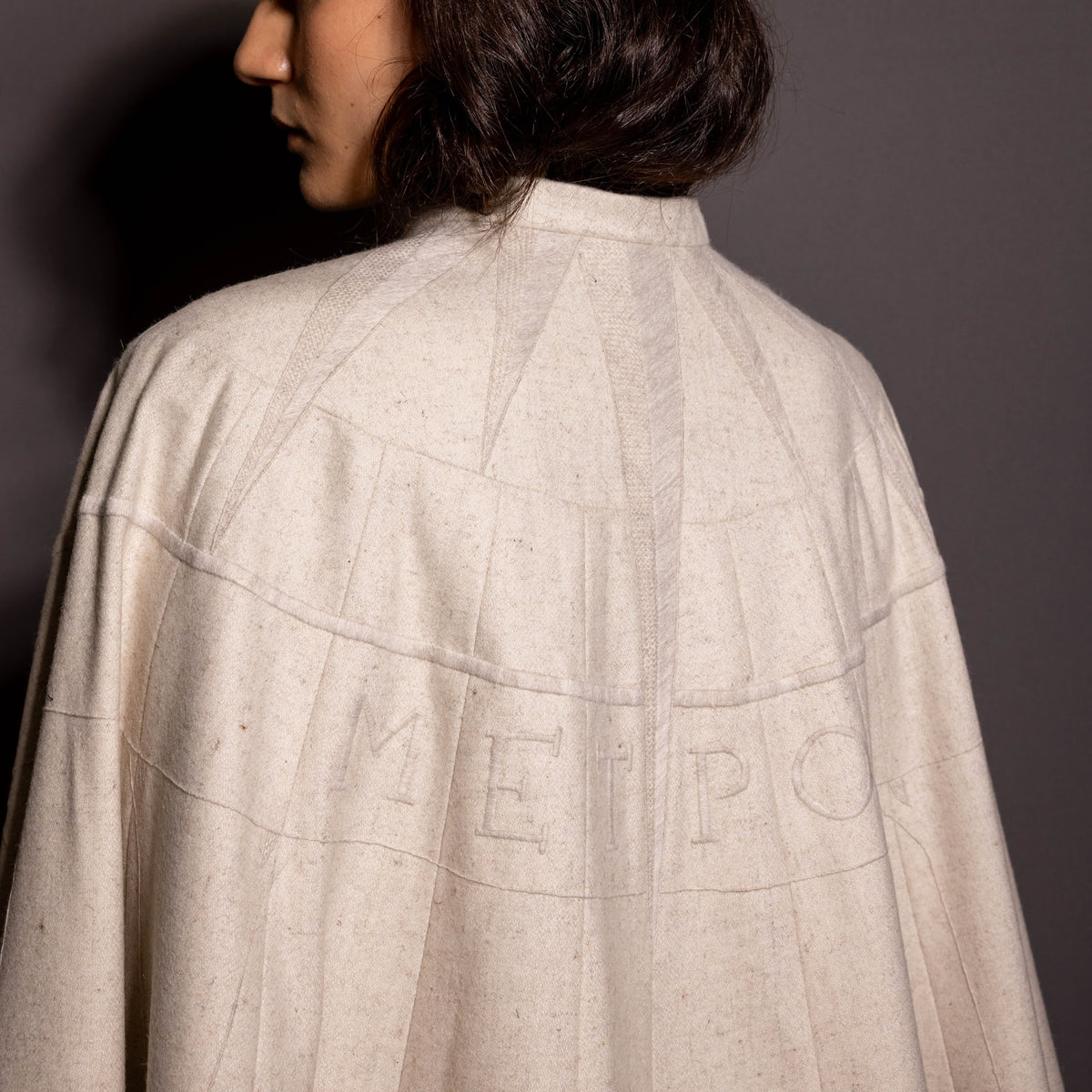
he tonal padded satin stitch, bullion knots, and whipped backstitch, much like architectural bas relief, communicate through light and shadow rather than colour


First Place Winner
The piece illustrates Apollo’s slaying of the Python as the primary western Ur-narrative of the light logos conquering the dark; this logic is embedded not only on the garment’s surface, but in its structure, with seams forming a sundial calibrated to Delphi. The tonal padded satin stitch, bullion knots, and whipped backstitch, much like architectural bas relief, communicate through light and shadow rather than colour.
The vertical composition reads as an ascent from the chthonic to the solar; the lower register carries the egg-and-dart apeiron, the Python coiling upon the omphalos stone. Through the middle, rows of tree-columns following classical Doric proportions illustrate the sacred grove becoming temple. The upper register is the aether, the Python pierced by the arrows not of a profane archer, but Apollo as the solar principle itself; upon the entablature is inscribed the Greek μέτρον/ΜΕΤΡΟΝ (‘measure’), a word carrying the same dual sense as in English— both the measurement of time and space (and Apollo as the geometrician god), and the restraint of proportion, the Delphic ‘nothing in excess.’ Framing the solar motif, it recalls Plato’s identification of the sun with the Good, through which all things become intelligible.
The title of the work is drawn from the closing lines of Pindar’s Pythian Ode VIII.
he tonal padded satin stitch, bullion knots, and whipped backstitch, much like architectural bas relief, communicate through light and shadow rather than colour
GSPR担当者: Ulster Bullion Ltd, 6b Upper Water Street, Newry, Northern Ireland, BT34 1DJ